Currently Empty: £ 0.00

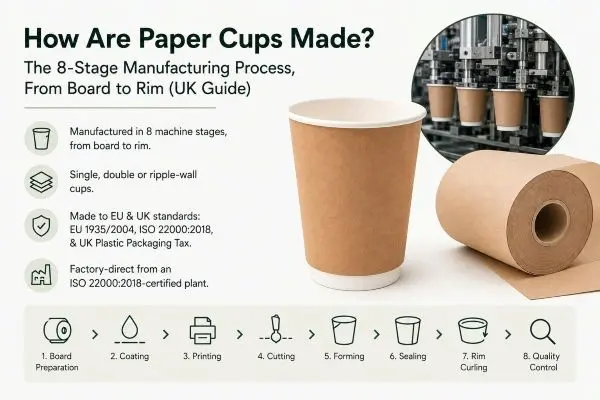
A paper cup is manufactured by converting a reel of food-grade paperboard into a lined, printed, and sealed vessel through eight machine stages, from board preparation to the curled drinking rim.
Each cup begins as three materials, then passes through coating, printing, cutting, forming, and sealing before quality control and packing. A single-wall cup forms in under a second on the line, costs a few pence to produce, and reaches the counter as a single, double, or ripple-wall variant.
Manufacture across the United Kingdom and European Union sits under three reference points: EU Regulation 1935/2004 on food-contact materials, the ISO 22000:2018 food-safety management standard, and the UK Plastic Packaging Tax, which shapes the choice of lining.
EcoLife writes this from the production floor, sourcing factory-direct from an ISO 22000:2018-certified plant, so the account below reflects how cups are actually made rather than a second-hand summary. Before the machines start, every cup begins as three materials, so that is where the process begins.
What Is a Paper Cup Made Of?
A paper cup is made of three layers: a food-grade paperboard body, a waterproof lining, and food-safe inks with a seam adhesive. The paperboard gives the cup its shape and rigidity, the lining stops liquid soaking through the fibres, and the inks carry branding on the outer wall while the adhesive holds the side seam and base. Board weight runs between 250 and 320 gsm, with the sidewall lighter than the base disc because the base carries more mechanical load.
Details of each layer sit in What Are Paper Cups Made Of and Paper Cup Materials & Linings Explained. Each layer is chosen for one job, so begin with the layer that gives the cup its shape.
| Layer | Material | Function | Typical spec |
| Body | Food-grade paperboard | Structure and rigidity | 250-320 gsm, virgin fibre |
| Lining | PE, PLA, or water-based coating | Liquid barrier | 12-18 gsm coat weight |
| Print and seam | Low-migration inks, hot-melt or water-based adhesive | Branding, seam and base bond | Outer wall only |
Food-Grade Paperboard: The Structural Base
Food-grade paperboard is the virgin-fibre board that forms the cup body and holds its shape when filled. Manufacturers use virgin fibre rather than recycled stock because food-contact rules restrict recycled content next to a drink, and virgin fibre carries the wet strength a hot liquid demands.
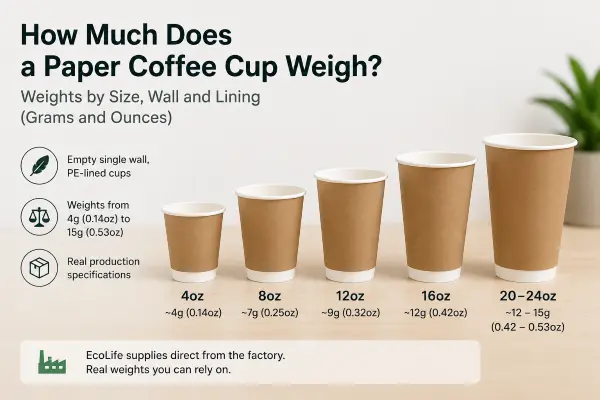
Grammage, measured in grams per square metre (gsm), scales with cup size and wall type: a 12oz single-wall cup uses board around 280 to 300 gsm, while smaller cups run lighter, a relationship covered in Measure GSM for Paper Cup.
The board arrives certified under FSC-Certified Paper Cups chain-of-custody schemes, which trace fibre back to responsibly managed forests, a point expanded in Kraft Paper in Packaging. A rigid base is only useful once it can hold liquid, which is the job of the lining.
The Waterproof Lining: PE, PLA and Water-Based Coatings
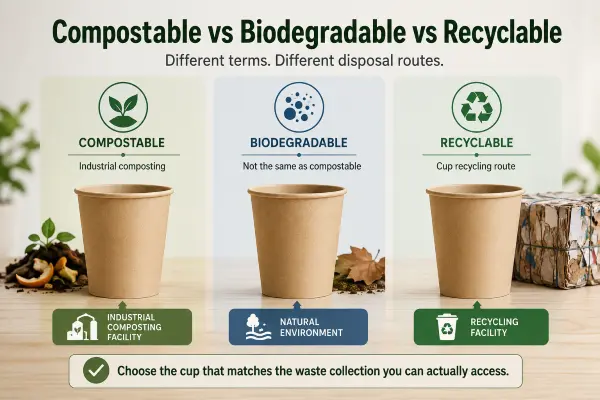
The waterproof lining is the thin coating bonded to the inside face of the board so the cup holds liquid without softening. Three coatings cover most production. Polyethylene (PE) is a petroleum-derived film, common and reliable, though it complicates recycling because the plastic must be separated from the fibre. PLA is a plant-derived polymer that needs the controlled conditions of a specialist industrial facility to break down, so it should not enter home bins or standard kerbside collection.
Water-based dispersion coatings use far less plastic and repulp more readily in standard mills. The lining also sets a cup exposure to the UK Plastic Packaging Tax: a plastic coating below 30% recycled content brings the component into scope of the tax, charged at £228.82 per tonne from 1 April 2026.
The trade-off between coatings is set out in PLA vs PE Lining and Do Paper Cups Have Plastic. Whichever barrier is chosen, it must sit beneath print that never touches the drink.
| Coating | Source | Recyclability | Best use |
| PE | Petroleum | Needs specialist separation | High-volume, low-cost ranges |
| PLA | Plant-derived | Specialist industrial processing only | Eco-positioned ranges |
| Water-based | Mineral and polymer dispersion | Repulps more readily | Lower-plastic ranges |
Food-Safe Inks and Seam Adhesives
Food-safe inks and seam adhesives are the low-migration printing inks and the water-based or hot-melt adhesives that brand and bond the cup. The inks sit on the outer wall only, never on the liquid-contact face, and they meet migration limits so no measurable substance transfers into the drink.
The side seam and base rely on the lining itself as a heat-set bond, supported by a food-grade adhesive at the join. Under EU Regulation 1935/2004, any material near food must not transfer its constituents in amounts that could harm health, which governs both ink chemistry and placement, as Food-Safe Paper Cups: What ISO Means explains further. Printing is applied to the flat reel before forming, so the graphics register cleanly across the finished wall. With the three materials defined, the line can begin, starting with the board itself.
The 8 Stages of the Paper Cup Manufacturing Process
The paper cup manufacturing process runs through eight machine stages: sourcing and preparing the board, applying the barrier coating, printing the reel, die-cutting the blanks, forming the body with a side seam, inserting and sealing the base, curling the rim, and quality control.
Stages five to seven run in sequence on a single forming machine at speed, which is why a finished cup leaves the line in under a second. Each stage below opens with its purpose, then the mechanism, then the defect it prevents, so the logic of the line stays visible. The line begins where the material does, with the board arriving at the factory.
| Stage | What happens | Output |
| Board prep | Certified reel selected, conditioned, checked | Ready board |
| Coating | Barrier applied to the inner face | Sealed board |
| Printing | Branding printed on the outer wall | Printed reel |
| Die-cutting | Sidewall and base blanks cut | Cup blanks |
| Forming | Blank wrapped, side seam sealed | Open cylinder |
| Base sealing | Base disc folded and heat-sealed | Closed cup |
| Rim curling | Top edge rolled outward | Rimmed cup |
| Quality control | Dimensional, leak, and heat tests | Verified cup |
Stage 1 – Sourcing and Preparing the Paperboard
The first stage secures certified board and conditions it for the line. Reels are selected by grammage and width to match the cup size, then conditioned to a stable moisture content so the board neither cracks nor curls during forming. Incoming quality control checks grammage, brightness, and contaminants before the reel is released. Most UK cups use bought-in certified board under FSC-Certified Paper Cups or PEFC chain-of-custody, not on-site pulping, which corrects a common claim that cups start from raw wood at the cup factory. Once conditioned, the board must be made able to hold liquid.
Stage 2 – Applying the Waterproof Barrier Coating
The second stage makes the board hold liquid by bonding a barrier coating to its inner face. Two methods cover most work: extrusion coating lays a molten PE film across the board, while dispersion coating applies a water-based or PLA layer that dries to a sealed surface. Coat weight typically falls between 12 and 18 gsm, cured so the barrier resists hot liquid without cracking at the fold. The coating governs both leak resistance and end-of-life recyclability, and it sets tax exposure: a plastic lining below 30% recycled content falls within the UK Plastic Packaging Tax, charged at £228.82 per tonne from 1 April 2026 on the current GOV.UK schedule. The coating options carry over to Water-Based Lining Paper Cups. A sealed board can now carry a brand, so the reel moves to print.
Stage 3 – Printing the Reel (Flexographic and Offset)
The third stage brands the outer wall while the board is still flat. Three print methods cover most orders:
- Flexographic printing uses flexible relief plates, runs fast, and suits long production runs.
- Offset printing transfers ink through a blanket roller, holds fine detail, and suits shorter runs with complex artwork.
- Digital printing prints without plates and suits short custom runs.
All three use food-safe inks and hold a tight registration tolerance so text and logos sit square on the finished cup. Print is applied before cutting, so a single reel yields thousands of identical branded blanks, which is the basis of Custom Printed / Personalised / Branded Paper Cups UK and the run-length logic in Guide to Branded Paper Cups. Printed board is still flat, so the next stage gives it a cup shape by cutting the blank.
Stage 4 – Die-Cutting the Cup Blanks
The fourth stage cuts the flat board into the two shapes a cup needs: a fan-shaped sidewall blank and a circular base disc. Rotary die-cutting uses a cylindrical die for high-speed continuous work, while flatbed die-cutting presses a flat die for precision on heavier board. Cutting holds a tolerance near +/-0.1 mm (+/-0.004 in), because the fan geometry sets the cup taper and final capacity. Cups from 4oz to 24oz share the same tooling logic, with the fan angle and radius scaled to each size, a mapping detailed in Paper Cup Sizes Guide. With blanks cut to size, the flat pieces are wrapped into a cylinder.
Stage 5 – Forming and Side-Seam Sealing
The fifth stage turns the flat blank into a cylinder with a sealed vertical seam. The forming machine performs it in three steps:
- The sidewall blank wraps around a heated mandrel that holds the cup shape.
- The overlapping edges heat-seal against each other, melting the lining into a bonded seam.
- The mandrel indexes forward to the base-sealing station.
An even seam overlap matters because an uneven or cold seam is the origin of side leaks. This machine also carries out stages five to seven in one continuous sequence, and it is the same platform that builds Single Wall vs Double Wall constructions. A sealed cylinder still has an open base, which the next stage locks shut.
Stage 6 – Bottom Insertion and Heat-Sealing
The sixth stage creates a leak-proof base. A circular disc is cut, folded down into the heel of the cylinder, and heat-pressed so the lining fuses the base to the wall; some lines use ultrasonic sealing for a faster, cooler bond. The heel joint, where base meets wall, is the commonest leak point in a finished cup, so seal temperature and dwell time stay within a narrow band to fuse the fibres fully without scorching them. Correct base sealing is what lets a cup hold hot liquid safely, as covered in Are Paper Cups Safe for Hot Drinks. A sealed base leaves one rough edge at the top, smoothed in the next stage.
Stage 7 – Rim Curling
The seventh stage forms the drinking edge by rolling the top of the cup outward into a curled rim. The curl stiffens the whole cup, gives the lips a smooth edge, and creates the lip that seats a lid. Rim diameter, commonly 80 mm (3.1 in) or 90 mm (3.5 in), governs which lids fit, so a cup and its lid share a rim spec by design. Curl consistency also affects how cleanly cups nest for stacking and transport. A finished cup is not shipped until it is proven safe, so the final stage tests it.
Stage 8 – Quality Control and Leak Testing
The eighth stage verifies safety and consistency before packing. On the EcoLife line, every batch passes a fixed set of checks tied to ISO 22000:2018 process control and food-contact migration limits, with results logged against a batch number for traceability. The full protocol underpins Lab-Tested Paper Cups and Paper Cup Quality Standards UK.
| Test | What it checks | Pass criterion |
| Dimensional | Height, diameter, rim | Within size tolerance |
| Leak (hot and cold) | Seam and heel integrity | No seepage over the test period |
| Heat resistance | Wall and lining under hot liquid | No softening or delamination |
| Rim and seam strength | Structural bond | Holds the rated load |
| Coating adhesion | Lining bond to the board | No lift or flake |
| Hygiene | Contamination control | Meets food-contact limits |
A cup that passes every check is only worth as much as the process behind it, which is where standards come in.
How Long Does It Take to Manufacture One Paper Cup?
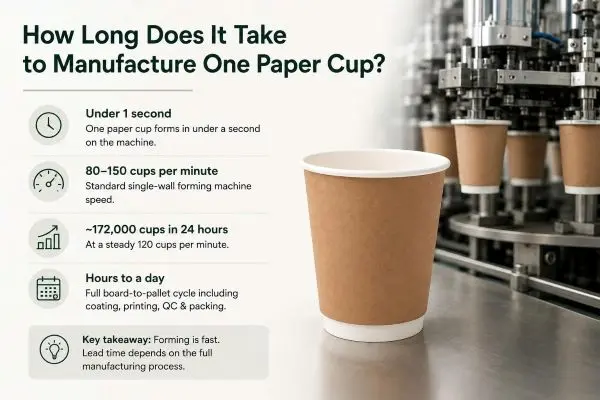
One paper cup forms in under a second, but the full board-to-pallet cycle spans hours to a day. A standard single-wall forming machine runs between 80 and 150 cups per minute, so an individual cup takes a fraction of a second at the forming stage itself. At a steady 120 cups per minute, one machine produces around 172,000 cups over a 24-hour run.
The distinction that matters to a buyer is machine speed against order lead time: forming is quick, but coating, printing, curing, cutting, quality control, and packing extend the end-to-end cycle, and a custom-printed order adds plate or file setup before the line starts. Lead-time reality is set out in Paper Cups Wholesale UK: Price, MOQ, Delivery and Next-Day Paper Cup Delivery UK. How fast a cup is made matters less to most buyers than how a cup differs by wall type.
How Is a Single-Wall Cup Made Differently From a Double-Wall or Ripple Cup?
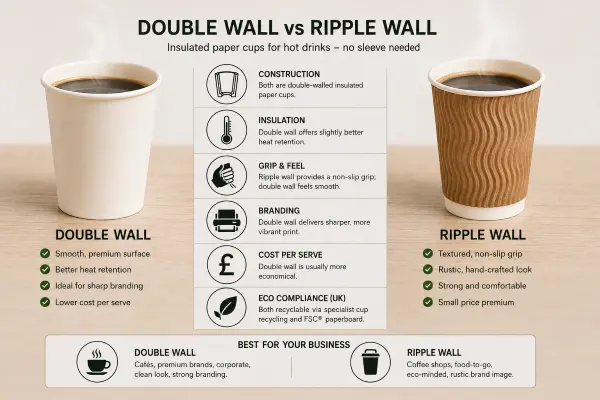
All three wall types share the same eight stages; double-wall and ripple cups add one forming step that bonds a second outer layer for insulation. A single-wall cup is a single formed body. A double-wall cup wraps a smooth outer sleeve around that body, trapping a thin air gap.
A ripple cup wraps a fluted outer layer, whose corrugations hold more air and give a textured grip. The extra layer adds material and cost and improves heat insulation for the hand holding the cup. The choice between them is compared in Single Wall vs Double Wall, Ripple Wall vs Double Wall, and What Are Ripple Cups.
| Feature | Single wall | Double wall | Ripple |
| Extra step | None | Bonded smooth sleeve | Bonded fluted sleeve |
| Insulation | Basic | Improved | Highest of the three |
| Relative cost | Lowest | Mid | Higher |
| Best use | Cold drinks, short serves | Hot drinks, takeaway | Hot drinks, premium serve |
Whichever construction a factory runs, all must meet the same UK and EU standards.
Which Quality and Safety Standards Govern Paper Cup Manufacture in the UK and EU?
Paper cup manufacture in the UK and EU is governed by three reference points: food-contact material law, a food-safety management standard, and responsible-sourcing certification. Food-contact law sets what may touch a drink, the management standard proves a factory controls its process, and sourcing certification traces the fibre. The first frame is the law that governs what may touch a drink.
Food-Contact Regulation: EU 1935/2004 and UK Equivalents
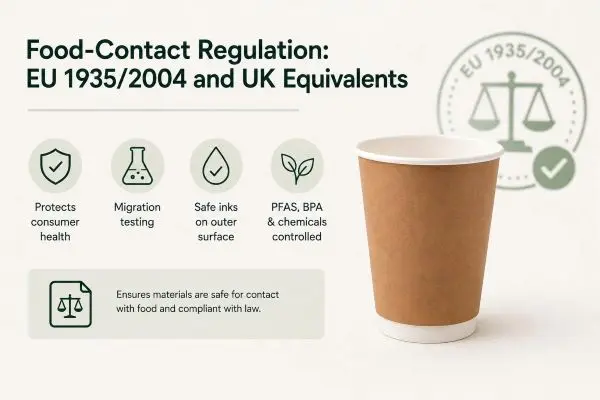
EU Regulation 1935/2004 is the framework law for food-contact materials, requiring that no material transfer its constituents into food in amounts that could harm health or change the food unacceptably. After 2021 the United Kingdom retained this regime in domestic law, so cups sold in Great Britain meet an equivalent standard. In practice the rule drives migration testing, where a cup is exposed to food simulants and the transfer of substances is measured against set limits.
It also explains why inks stay on the outer wall: keeping print off the liquid-contact face removes a migration pathway. Chemistry of concern such as PFAS and BPA falls under the same scrutiny, a topic handled in Do Paper Cups Contain PFAS or BPA and Are Paper Coffee Cups Bad For You, and responsibly made cups are formulated to stay within the limits rather than relying on assurances alone. Law sets the floor; certification proves a factory clears it, which is the second frame.
ISO 22000 and FSC / PEFC Certification
ISO 22000:2018 is the food-safety management standard, and FSC and PEFC are the chain-of-custody schemes for responsibly sourced fibre. ISO 22000 sets out how a factory identifies hazards, controls critical points, and documents each batch, so certification proves a working safety system rather than a one-off test. FSC and PEFC trace paperboard from a certified forest through every handler to the finished cup, so the claim of responsible sourcing can be audited.
A buyer verifies both by asking for the current certificate and checking the number against the issuing body public register, as set out in Product Certifications (ISO 22000). EcoLife manufacturing partner holds ISO 22000:2018 certification, and the board runs under chain-of-custody, so both claims rest on documents a customer can request. A practical step for any buyer is to ask a supplier for current certificates before the first order. Standards explain what a good cup costs to make, which raises the price question.
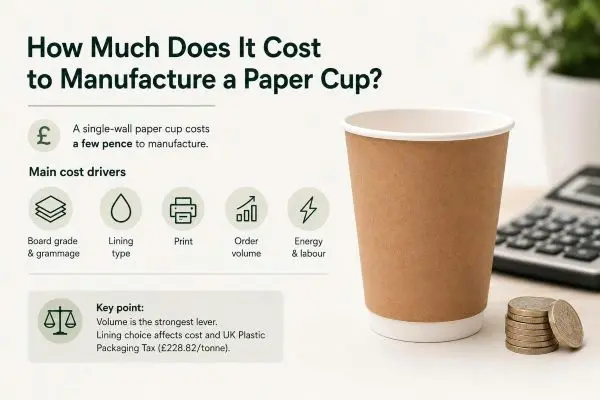
How Much Does It Cost to Manufacture a Paper Cup?
A single-wall paper cup costs a few pence to manufacture, with the exact figure set by a handful of drivers. The main cost drivers are:
- Board grade and grammage: heavier and higher-grade board raises material cost.
- Lining type: PLA and water-based coatings usually cost more than standard PE.
- Print: more colours and shorter runs raise the per-cup print cost.
- Order volume: larger runs spread setup and lower the unit cost.
- Energy and labour: coating, forming, and curing draw steady overhead.
Volume is the strongest lever, because setup cost divides across the run. Lining choice moves the figure both ways: a plastic coating below 30% recycled content adds Plastic Packaging Tax at £228.82 per tonne, while a lower-plastic lining can reduce that exposure, a comparison drawn out in Plastic Cups vs Paper Cups (Cost & Tax) and Cost Per Paper Cup. Factory cost is not the delivered UK price, which also carries import, storage, UK fulfilment, and margin. Cost naturally raises a bigger question: is making cups a business worth entering?
Is Paper Cup Manufacturing a Profitable Business?
Paper cup manufacturing can be profitable, but margins depend on scale, machinery capital, board sourcing, and competition, so the answer is conditional rather than automatic. On the opportunity side, demand is steady, the product is consumable and repeat-bought, and eco-positioned ranges command a premium. On the risk side, forming machinery and coating lines carry a high fixed-cost barrier, board is a bought-in commodity exposed to price swings, and factory-direct suppliers already compete hard on unit price.
A new entrant needs volume to cover fixed costs before per-cup margin turns positive, which favours established plants with full order books. None of this is financial advice; these are the factors a buyer or investor would weigh, and the numbers turn on local energy costs, machine utilisation, and access to certified board, as discussed alongside Choosing a Paper Cup Supplier. For most food businesses the real question is not whether to make cups, but whether to make or source them.
Should You Manufacture Paper Cups or Source Them From a Factory-Direct Supplier?
For most UK food businesses, sourcing factory-direct is the practical choice, because it removes the capital, compliance, and minimum-order burden that in-house manufacture imposes.
| Factor | Make in-house | Source factory-direct |
| Capital | High: forming and coating machinery | None |
| Compliance | You hold ISO 22000 and testing | Supplier holds and evidences it |
| Minimum volume | Tens of thousands per run | Low MOQ, per-case online |
| Custom print | Own plates and setup | Supplied as a service |
| Lead time | Full production cycle | UK stock, fast dispatch |
EcoLife runs the factory-direct model: stock made in an ISO 22000:2018-certified plant, held in the UK, with low minimum orders, custom printing, and fast delivery, free on UK orders over £99. The trade-off is laid out fully in Wholesale Paper Cups UK and How to Buy Paper Cups for Business Wholesale or Small Batch. A few recurring questions remain for anyone weighing manufacture against sourcing.
Frequently Asked Questions About Paper Cup Manufacture
Four questions recur once the process is clear: recyclability, plastic content, machine speed, and custom minimums. The first question buyers ask about any finished cup is whether it can be recycled.
Are Manufactured Paper Cups Recyclable?
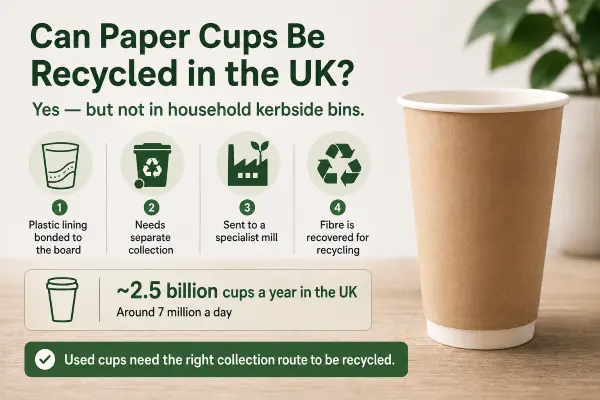
Manufactured paper cups are recyclable, but only at specialist facilities that separate the lining from the fibre. PE-lined cups need a dedicated recycling stream because the plastic film must split from the board, while water-based-lined cups repulp more readily in standard mills, as Are Paper Cups Recyclable explain. Standard household kerbside collection often cannot process lined cups, so recovery depends on drop-off points and trade collections rather than the home bin. Recyclability depends on the lining, which raises whether cups still contain plastic.
Do Finished Paper Cups Still Contain Plastic?
Most finished paper cups still contain a thin plastic lining, usually PE, unless they are made with a PLA or water-based coating. The plastic is the barrier that stops the drink soaking through, not the body of the cup. A lower-plastic option can be identified by its stated lining and its tax position, since a coating below 30% recycled content sits within the UK Plastic Packaging Tax, a distinction covered in Do Paper Cups Have Plastic.
The plastic question leads to how fast these cups can be produced at scale.
How Many Cups Can One Forming Machine Produce Per Minute?
A standard single-wall forming machine produces between 80 and 150 cups per minute, and high-speed lines exceed 200. At 120 cups per minute a single machine turns out roughly 172,000 cups in a 24-hour run, which is why finished-stock lead times depend more on scheduling and print setup than on raw forming speed. Output speed also shapes the minimum quantity a factory will custom-print.
What Is the Minimum Order to Have Cups Custom-Made?
Direct factory minimums for custom-printed cups run to tens of thousands per design, but factory-direct distributors set far lower minimums and offer sample packs. A factory prints to fill a full run, so its minimum suits large brands, while a distributor like EcoLife holds UK stock and prints smaller batches, which lets a single cafe or event order a modest quantity through Custom Printed Paper Cups Wholesale. A Paper Sample Cup / Pack lets a buyer test cups before committing. Understanding how cups are made is, in the end, the surest guide to sourcing them well.
From Production Line to Your Counter: Sourcing Responsibly-Made Paper Cups
A well-made paper cup comes down to four things a buyer can check: certified board, the right lining, precise forming, and verified quality control, the same criteria that separate one supplier from another. Certification proves the board and the food-safety system, the lining sets recyclability and tax position, forming and sealing decide whether the cup leaks, and documented testing confirms every batch. A buyer checklist follows from the process: ask for FSC or PEFC and ISO 22000 certificates, confirm the lining type, check the minimum order against real volume, and confirm UK delivery times.
EcoLife supplies against each of these points through Wholesale Paper Cups UK and Custom Printed / Personalised / Branded Paper Cups UK: factory-direct cups from an ISO 22000:2018-certified plant, a choice of linings, low minimum orders, custom printing, and fast UK delivery with free delivery over £99. A sample pack is the low-commitment way to judge the cup in your own hands before a full order. Good for business, better for the planet.